

Inform | Influence | Empower

Website Search:

News

NAHB Chief Economist: A rare opportunity for buyers?

01/21/2026

A Q&A with the chief economist at the National Association of Home Builders on construction trends, builder incentives and affordability.
For the first time in years, the price gap between newly built homes and existing homes is narrower than ever—and in some markets, the typical resale home is actually more expensive than a new build. A mix of builder price cuts, widespread incentives and smaller home sizes has brought new-home pricing more in line with resale values, creating a potentially unusual buying window for prospective home buyers.
But challenges persist in the new-home market. Overall, “2025 was a disappointing year for newly built single-family homes,” acknowledges Robert Dietz, the chief economist at the National Association of Home Builders. “We entered the year expecting relatively flat conditions, but with a mix of policy headwinds and economic opportunities, single-family home construction fell by about 7%. Builders consistently pointed to ongoing housing affordability challenges, along with supply side issues like a persistent skilled labor shortage.”
So, what lies ahead for the new-home market and for home buyers? Dietz shares his insights.
What’s your outlook for the new home market for 2026?
We are starting to see some modest improvements. One of the biggest tailwinds is the Federal Reserve’s easing [of its short-term interest rates] late in 2025. While the Fed doesn’t directly control mortgage rates, its actions matter a lot on the supply side—particularly for builders’ financing costs. About two-thirds of home construction is done by smaller, private builders who rely on bank loans to purchase land, materials and pay workers. When the Fed lowers the federal funds rate, it directly reduces the interest rates on construction and development loans. That’s good news for builders, inventory and ultimately for home buyers and renters.
For 2026, we’re forecasting about a 1% increase in single-family home building and a similar 1% gain in new home sales. Existing home sales should rise more sharply as inventory improves, but many of the same challenges—policy uncertainty, lingering tariff effects and the broader housing deficit—will remain.
Builder incentives have been making headlines and are helping to lower the costs for home buyers. Tell us more about what type of incentives builders are offering.
Incentives are very elevated right now, and that’s good news for buyers. About 40% of builders cut prices in December, with average reductions around 5%. Nearly two-thirds are also offering other incentives.
One of the most common tools—especially among larger builders—is mortgage rate buydowns. Builders are using their financial resources to lower buyers’ mortgage rates for the first two or three years, helping to ease monthly payment pressures. Other incentives include amenity upgrades and closing cost assistance, though there are limits to how much builders can offer. Still, it’s one of the industry’s main ways of responding to ongoing affordability challenges.
Historically, new homes have been more expensive than existing homes. But is that changing?
This is one of the real oddities in today’s data. Right now, the median resale home is actually more expensive than the median newly built home. That’s only happened a handful of times over the past few decades.
Typically, new homes carry a 10% to 15% price premium because they offer more amenities, lower maintenance costs and newer systems. But today’s builder incentives—combined with more construction happening in lower-cost areas—have flipped that dynamic.
It’s also a sign of the larger structural housing deficit. Even with inventory increasing in many markets, the housing stock simply hasn’t kept pace with population growth. That imbalance continues to show up in prices.
You’ve often said we need to “build our way out” of the affordability crisis. What does that look like?
The only long-term solution to housing affordability is more supply—more single-family homes, more multifamily units, more homes for sale and for rent. A clear indicator of the shortage is that nearly 20% of young adults now live with their parents. Historically, that figure was closer to 10%. That doubling is a direct reflection of the housing deficit we’re facing.
One area that’s seen growth on the construction side is townhomes. Why are they gaining traction?
Townhomes have been one of the bright spots in an otherwise challenging market. Today, about 18% of single-family construction consists of townhomes—up from less than 10% a decade ago.
They offer what we call “light-touch density”: a smaller lot, shared walls but still a front door and a path into homeownership. Demand is strong, particularly among younger buyers looking for walkable communities. The challenge is on the supply side—many zoning laws still limit this type of development.
We see real opportunity in redeveloping underused properties, like dying shopping malls, into mixed-use communities with apartments and townhomes. That kind of redevelopment could be a big part of the future.
Are builders also reducing costs by building smaller homes?
Absolutely. The median new-home size has been trending downward for about a decade. There was a brief post-COVID bump due to the “Zoom room” phenomenon, but overall, homes are getting smaller as builders respond to affordability pressures.
Between smaller lots, more townhomes and reduced square footage, builders are actively trying to right-size homes for today’s buyers and budgets—while also working with policymakers to bring costs down further.
Finally, what trends are you watching most closely in 2026 that could impact the new-home market?
Geography is a big one. Markets like Texas and Florida have cooled after years of rapid growth and some cyclical overbuilding. Meanwhile, we’re seeing pockets of strength in the Midwest—places like Columbus, Ohio, Indianapolis and Kansas City.
These markets remain more affordable, are close to major universities, and are well positioned for AI and tech investment, where managing energy and heat costs matters. In fact, single-family home construction in the Midwest was already up in 2025, even as it declined nationally. We expect that outperformance to continue into 2026.
Read More

GRI: Avoiding Setbacks, Fines & Lawsuits

01/21/2026

GRI: Avoiding Setbacks, Fines & Lawsuits (6 hr AL CE) IN-PERSON Date: Tuesday, March 31st […]

Read More

RE Technology: Future Proof Your Business in 2026

01/16/2026

The real estate industry is evolving faster than ever. New technology, powerful AI tools, and changing buyer expectations are rewriting how agents generate leads, communicate with clients, and close deals.
By 2026, today’s “nice-to-have” tech will be non-negotiable. Buyers and sellers expect instant responses, personalized experiences, and seamless digital communication. At the same time, competition is increasing and attention spans are shrinking.
To stay relevant and profitable, agents need to modernize how they work. Automation, AI, and smarter CRM strategies aren’t trends anymore, they’re the foundation of a future-proof real estate business.
Here’s how to stay ahead of the curve and build a business ready for 2026 and beyond.

Don't miss this upcoming FREE webinar from RE Technology and ValleyMLS:

Read More

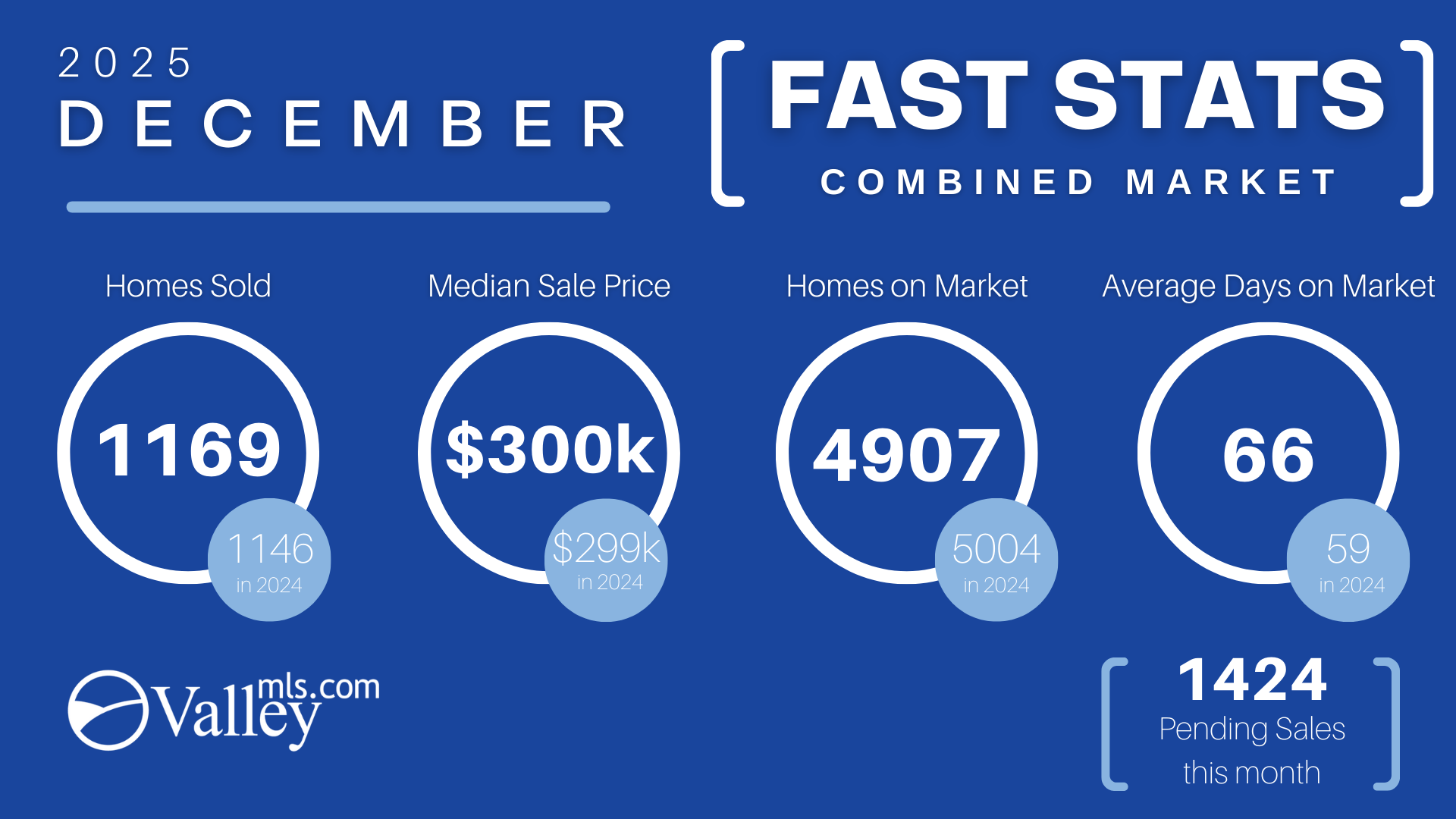
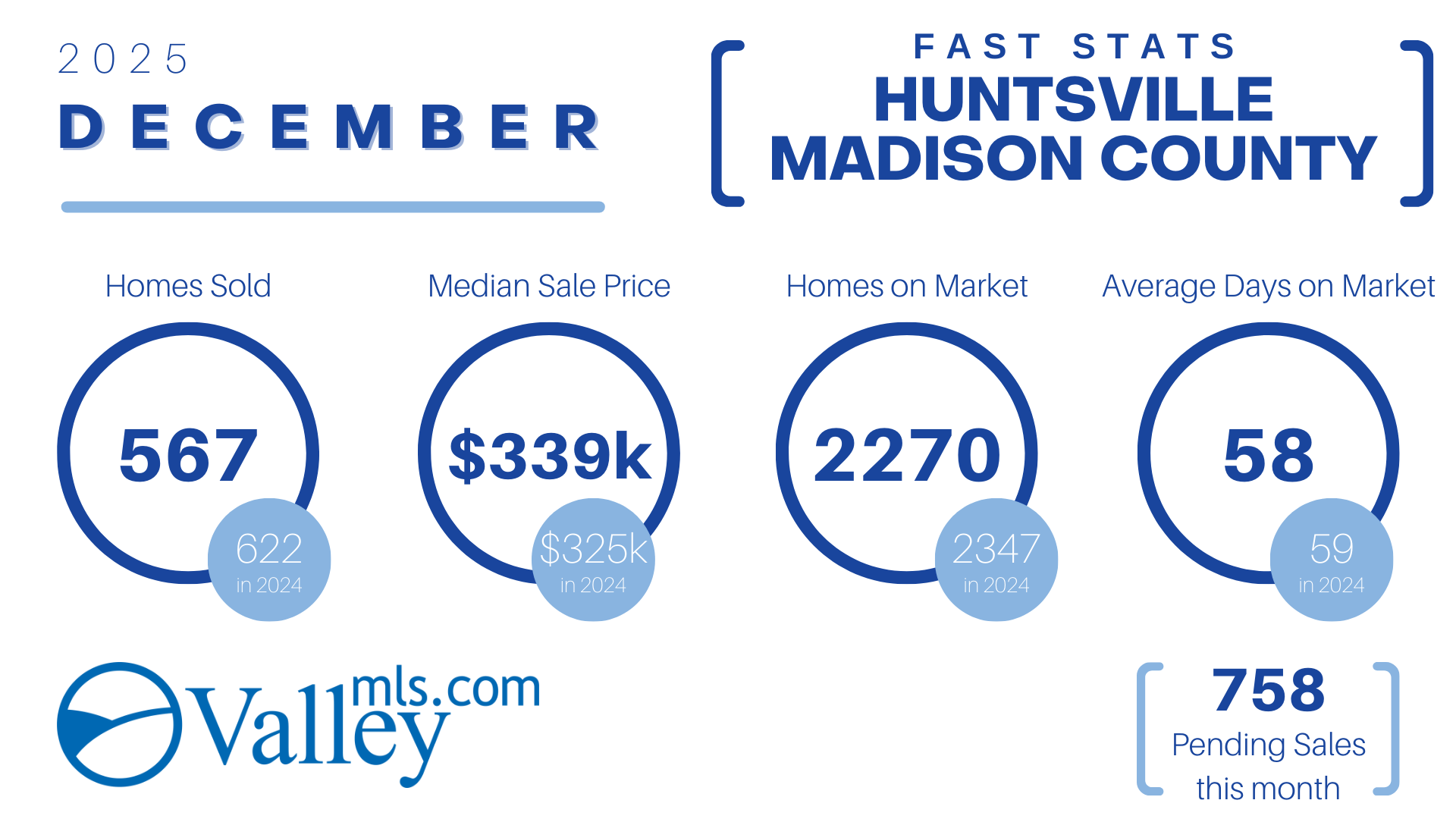
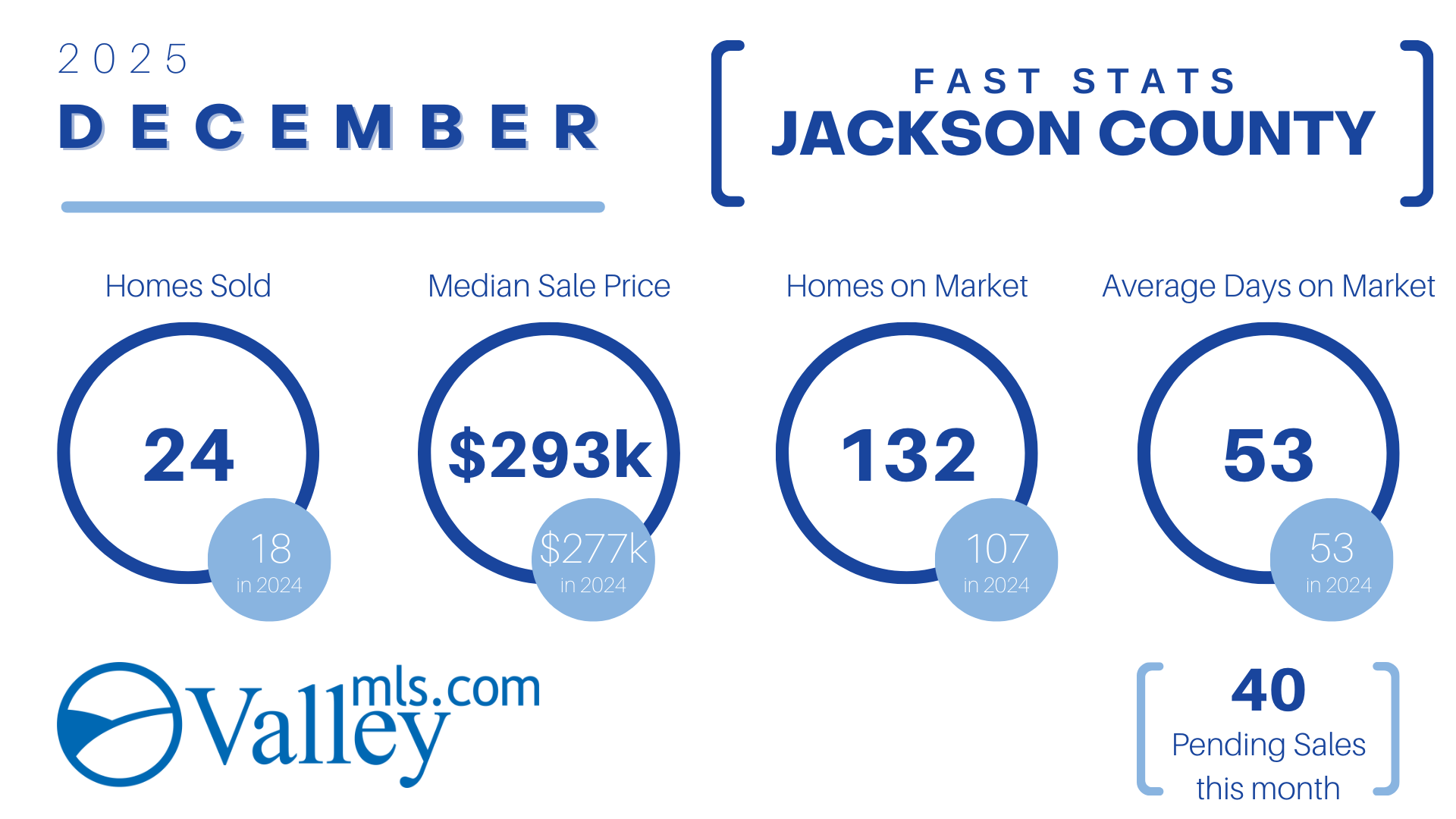
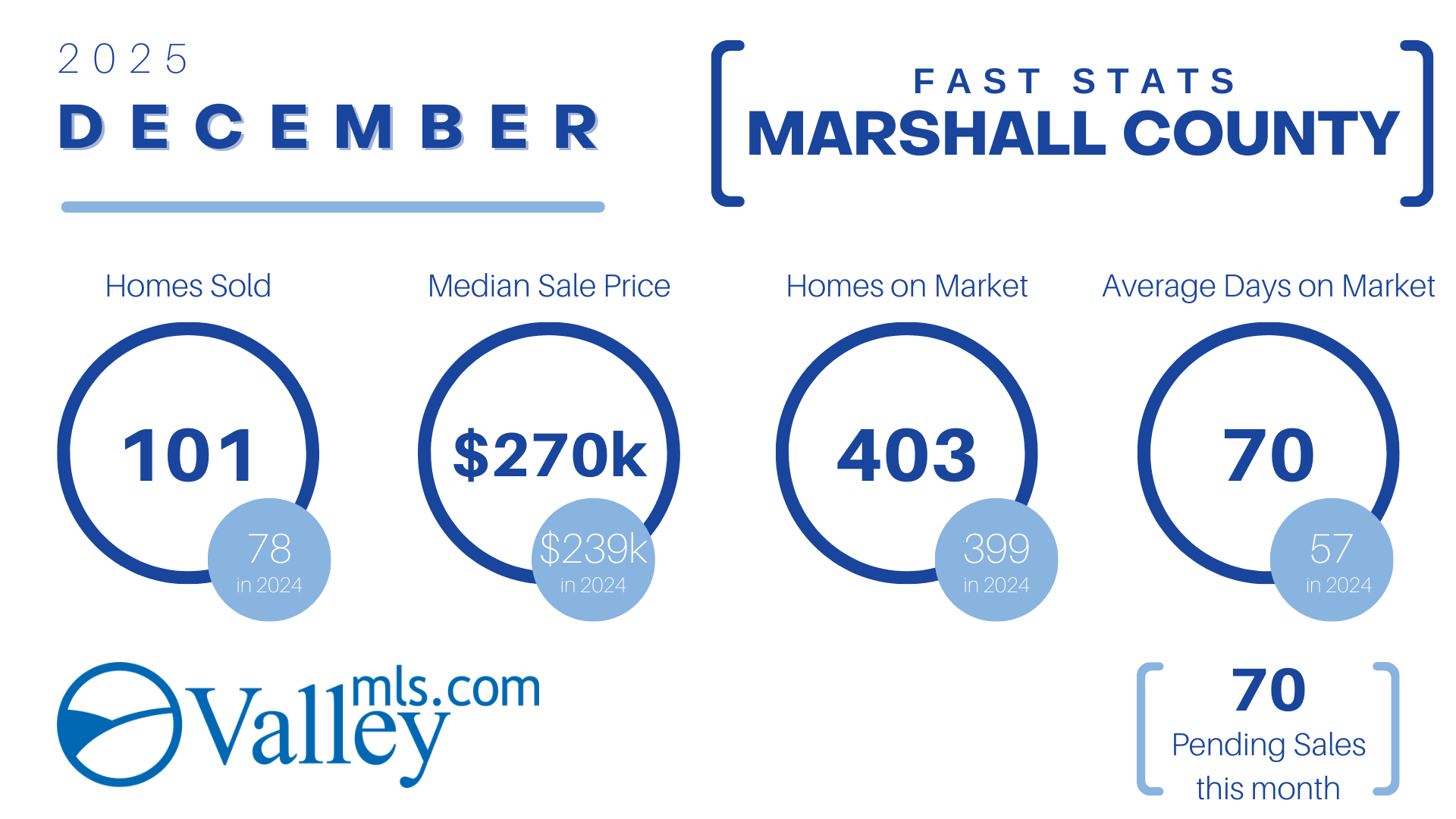
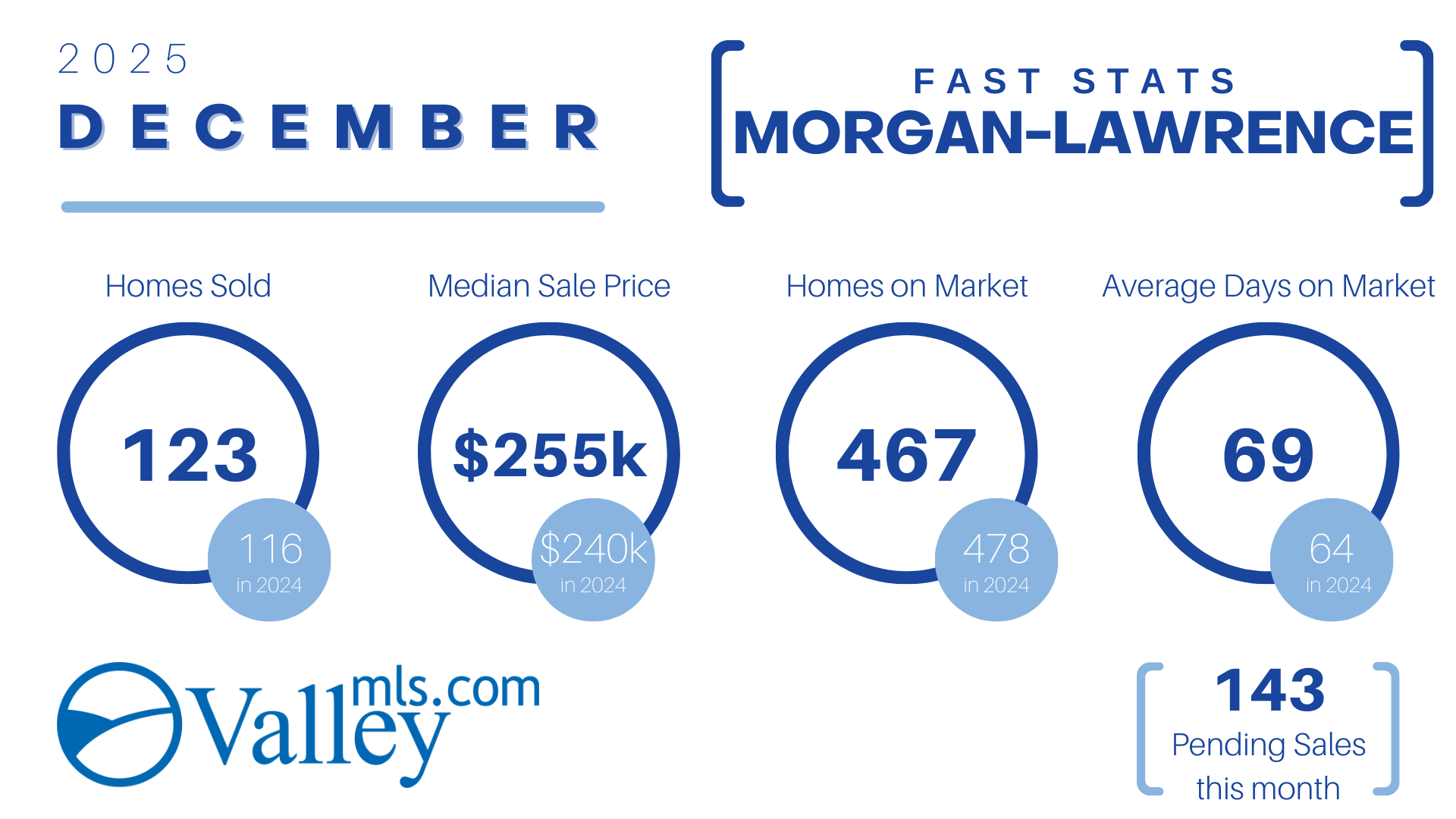
December 2025 Fast Stats

01/15/2026

Please note! Beginning in 2025, ValleyMLS will highlight MEDIAN Sale Price instead of AVERAGE Sale Price to reflect a more accurate overview of the local market for media and consumers.
As the year winded down, North Alabama’s real estate market is showing a unique blend of seasonal cooling and long-term resilience. While the holidays often bring a slower pace, the December 2025 data reveals that our area counties remain some of the most stable regions in the Southeast.
Below is a breakdown of the December stats across our key service areas.
Huntsville & Madison County
While inventory rose slightly to 965 active listings, well-priced homes are still moving in just under six weeks. The 0.986 sale-to-list ratio proves that sellers are still getting near-asking price, though buyers now have more room to negotiate than they did two years ago.
Athens & Limestone County:
Limestone County remains a hotbed for new construction. Growth along the I-65 corridor is keeping demand high, even with the typical December dip in activity. It remains an excellent alternative for those seeking slightly more “bang for their buck” while staying close to Huntsville’s job centers.
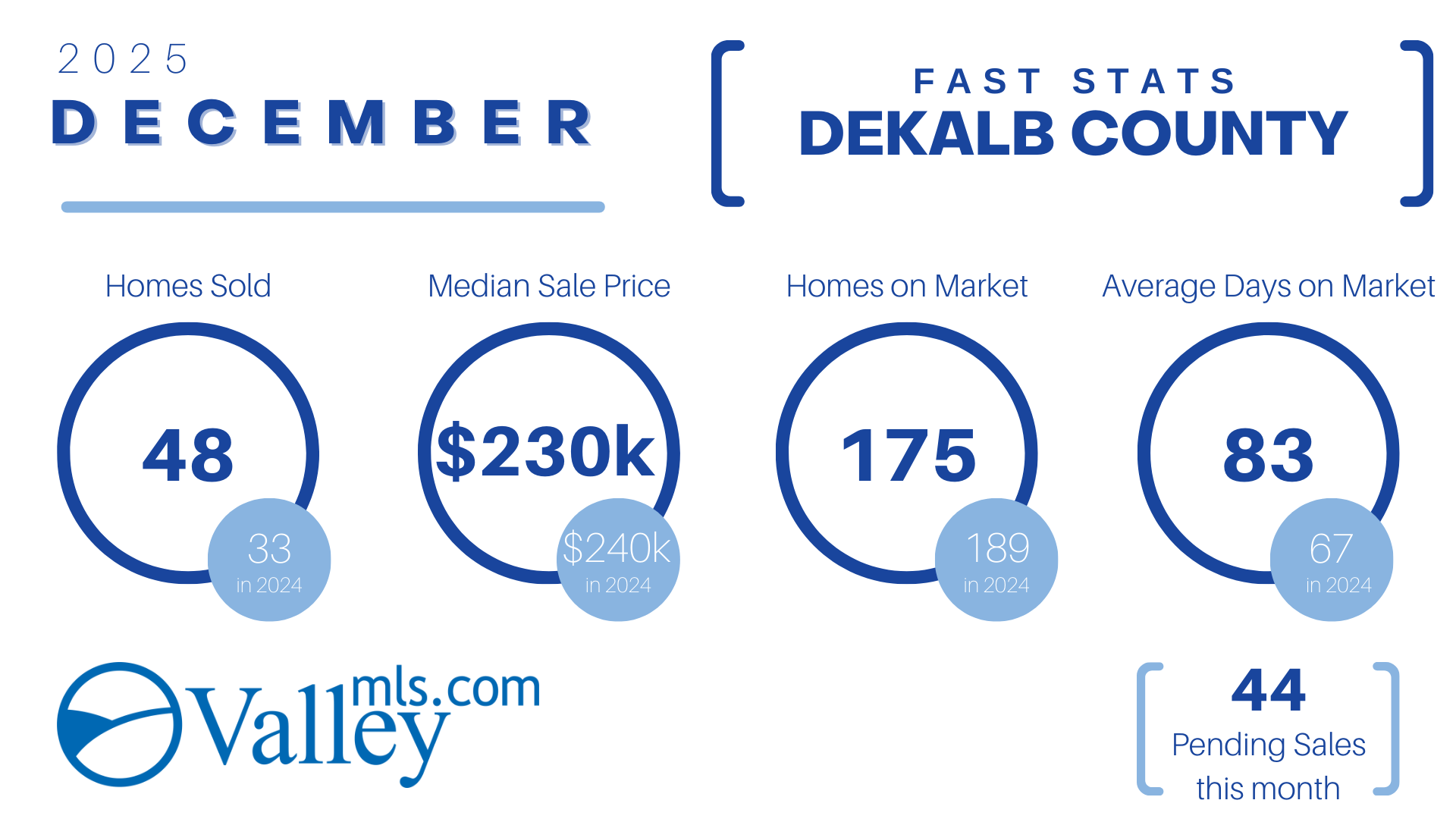
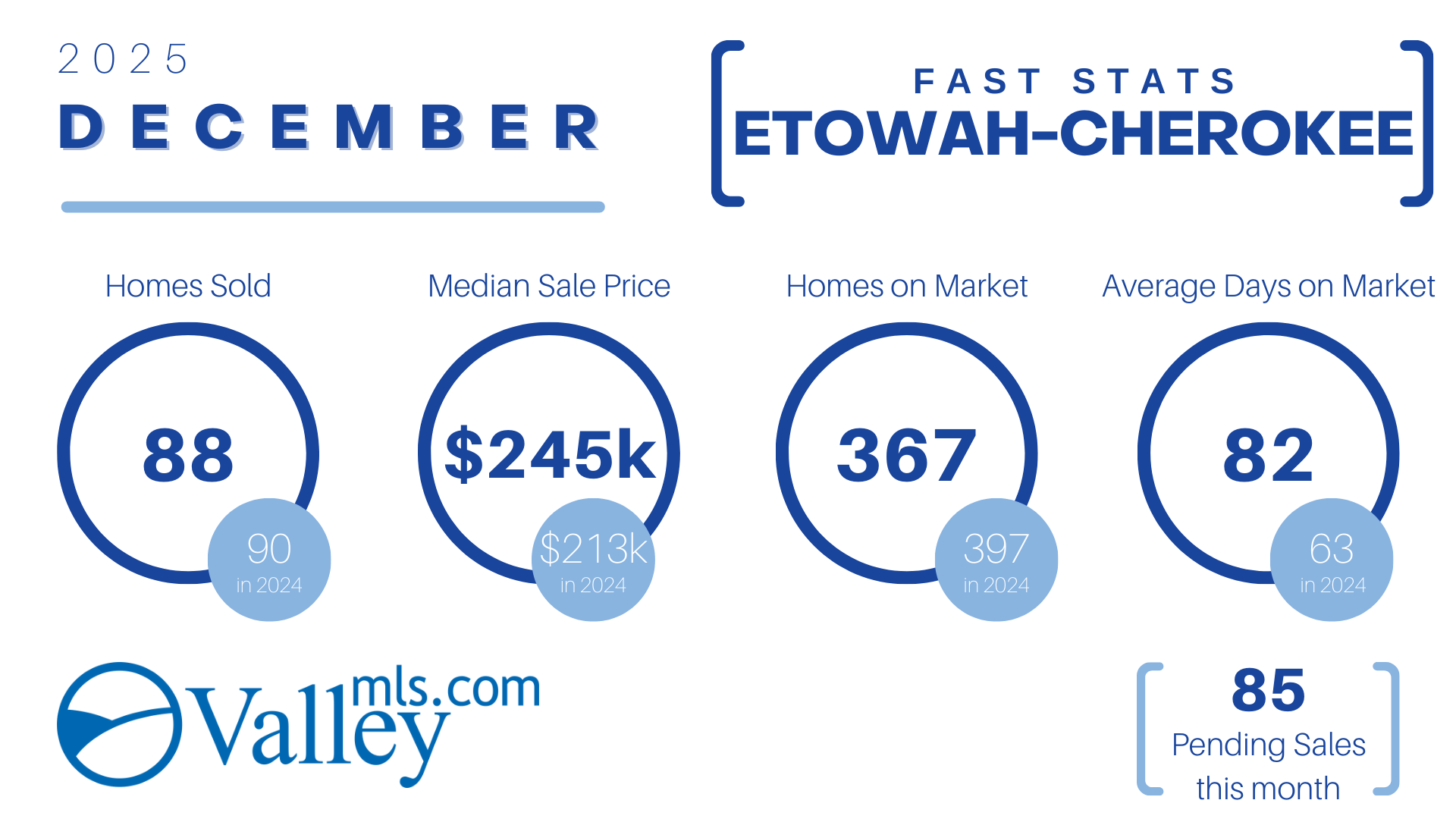
Morgan, Marshall, Etowah, DeKalb, & Jackson:
  • Morgan County: Stable pricing makes this a favorite for first-time buyers.
  • Marshall & Jackson: We’re seeing a steady interest in recreation-adjacent properties near Guntersville Lake.
  • Etowah & DeKalb: Inventory remains the tightest here, keeping prices firm as we head into the new year.

ValleyMLS.com Market Stats include statistics from the following cities/counties: Athens, Limestone County, Dekalb County, Etowah County, Cherokee County, Huntsville, Madison County, Jackson County, Marshall County, Morgan County, Lawrence County

Read More

FAQ: First Right of Refusal FROR & MLS Status Reporting

01/09/2026

A First Right of Refusal (FROR) — sometimes referred to as a “break clause” — is a contractual provision under which a seller accepts an offer that allows a buyer the right to submit an offer to include a  “break clause” of the potential buyer first getting an offer on their current home with a “First Right of Refusal” to either void the contract or remove the contingency of the purchaser first getting their home under contract if the seller receives another offer.
For MLS reporting and compliance purposes, a First Right of Refusal and a break clause are treated identically. Once an offer is accepted—regardless of the terminology used—the property is considered under contract and must be reported accordingly in the MLS.
Does calling it a “break clause” change how the listing is reported in the MLS?
No.
Regardless of whether the contract uses the term First Right of Refusal or break clause, MLS reporting requirements remain the same.
Terminology does not override MLS status rules.
 
Does a listing with an FROR or break clause remain Active?
Yes, but once an offer is accepted or the FROR is exercised, the listing is no longer Active.
 
What status is required when there is an accepted offer with an FROR or break clause?
The listing must be updated to the appropriate status (Contingent or Pending) within three (3) working days of acceptance.
This requirement applies even if:
  • Contingencies remain
  • Inspections have not occurred

Why can’t the listing remain Active while waiting for contingencies or inspections?
An accepted offer places the seller under contract. Leaving the listing Active is misleading to:
  • Cooperating brokers
  • Buyers
  • The public
MLS data must reflect the property’s true contractual status, not marketing strategy.


How should an FROR or break clause be disclosed in the MLS?
MLS Participants must:
  • Use the MLS-designated field and remarks to disclose the FROR.
  • Ensure remarks accurately describe the situation
  • Keep information current as circumstances change

When does the three (3) working day requirement begin?

The three (3) working day period begins when the offer is accepted by all required parties, not when:
  • Earnest money is received
  • There are no contingencies
  • Waiting for mortgage approval
Working days exclude weekends and MLS-recognized holidays.


What happens when the FROR is exercised or waived?
The listing must be updated promptly to reflect the resulting contract status and any changes to remarks or contingencies.


What happens if I fail to update the status within three (3) working days?
Failure to comply may result in:
  • Compliance notices
  • Fines or other sanctions as outlined in MLS Rules
The MLS may request documentation to verify compliance.


Does ValleyMLS interpret contract language or provide legal advice?
No. ValleyMLS does not interpret contracts or provide legal advice. The MLS’s role is limited to enforcing accurate and timely MLS reporting, regardless of how contractual provisions are labeled.


Bottom Line
Different names. Same rule.
If an offer is accepted:
  • The listing is Under Contract
  • The status must be updated within three (3) working days
Read More

Beginning with the End in Mind: The ALTA Settlement Statement (3 CE)

01/09/2026

Beginning with the End in Mind: The ALTA Settlement Statement (3 CE) Date: Wednesday, February […]

Read More

NAR’s Code of Ethics

01/09/2026

NAR’s Code of Ethics (3CE) Date: Wednesday March 25th, 1:00 pm – 4:00 pm  Location: […]

Read More

Contract to Table – Road Map of a Real Estate Closing (3 CE)

01/09/2026

Contract to Table – Road Map of a Real Estate Closing (3 CE) Date: Tuesday, […]

Read More

Environmental Issues within Legal Description Ownership (3 CE)

01/09/2026

Environmental Issues within Legal Description Ownership (3 CE) Date: Wednesday, March 4th, 2026  1:00 pm […]
Read More

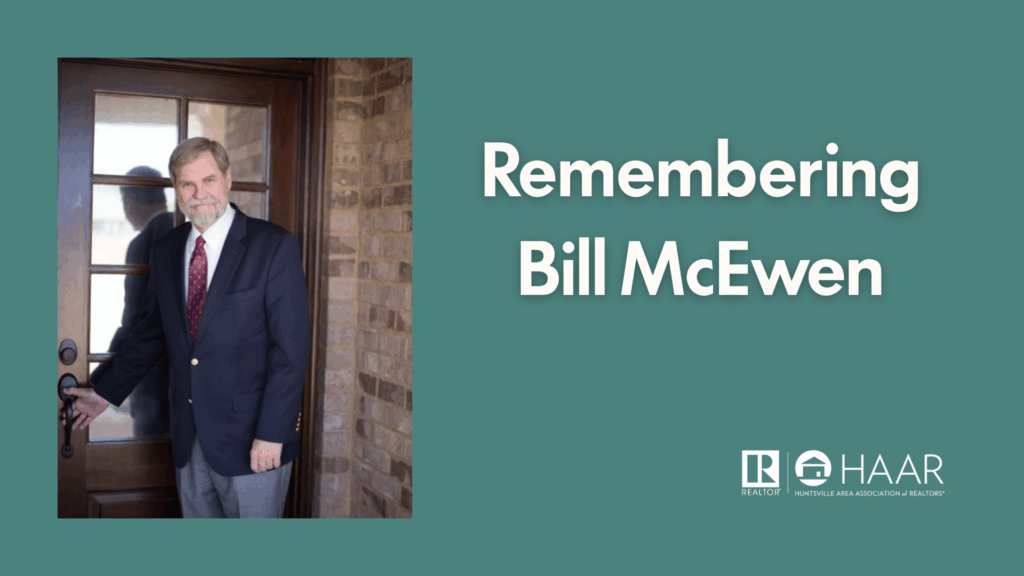
In memory of Bill McEwen

01/07/2026

Bill McEwen, age 71, of Huntsville passed away on January 4, 2026, in Huntsville, Alabama.
Bill was a lifelong resident of Huntsville, Alabama and a graduate of Lee High School. He was a Realtor with Legend Realty and worked in real estate for the Huntsville metro area for over 48 years.
Visitation
Thursday, January 8
10:00am – 12:00pm
First Baptist Church
600 Governor’s Drive
Huntsville, AL 35801
Funeral Service
Thursday, January 8
12:00pm
First Baptist Church
600 Governor’s Drive
Huntsville, AL 35801
He loved cruising in his vintage Ford Mustangs with the top down and spending weekends at car shows. A lifelong enthusiast, he had a passion for toys of all kinds and often turned the dining room table into a racetrack for his collection of toy race cars. Known for his quick wit and endless supply of dad jokes, he cherished making his kids laugh and embraced his role as “Big Daddy” to his grandkids—a source of comfort and joy, even for his beloved grand dog.
Survivors include his wife, Andra Massey McEwen; his daughters, Brandi McEwen, Ellyn Christian (husband, Kyle) and Britney McEwen; his grandchildren, Emma, Evelyn and KC Christian; sister, Charlynn Jackson (husband, Harold); and several nieces and nephews.
He was preceded in death by his parents, Charles and Evalyn McEwen and his brother, Charlie McEwen.
Visitation will be from 10:00 a.m. to 12:00 p.m. on Thursday, January 8, 2026, at First Baptist Church Life Center, Huntsville, Alabama. The funeral service will follow at 12:00 p.m. with Rev. John Lemons officiating. Burial will be in Maple Hill Cemetery.
In lieu of flowers, the family requests that memorials be made to the First Baptist Church Mission Fund in his memory.
Read More