The number of American adults who identify as lesbian, gay, bisexual, transgender, or gender nonbinary (LGBTQ+) has nearly tripled in the last decade, from 3.5% in 2012 to 9.3% in 2024, according to a recent Gallup study. This translates to over 31 million people and is a trend propelled by younger generations. For instance, 14% of Millennials and 23% of Generation Z now identify as LGBTQ+.
This demographic shift is increasingly reflected in the real estate market. The National Association of Realtors (NAR) reports that the proportion of LGBTQ+ homebuyers and sellers has risen to just over 5% in 2024. As Millennials and Gen Z continue to enter the housing market, this number is poised to grow further.
NAR’s data also uncovers unique characteristics and challenges for the LGBTQ+ community in their homeownership journey. Compared to their non-LGBTQ+ counterparts, LGBTQ+ individuals are more likely to be first-time buyers (46% versus 29%) and first-time sellers (40% versus 28%). This is partly due to the community’s younger average age. However, the data also suggests that LGBTQ+ buyers and sellers face distinct obstacles and often make different and greater sacrifices to purchase a home in today’s challenging market.
Income and Household Characteristics
As in 2021, LGBTQ+ buyers and sellers earn slightly less than non-LGBTQ+; most of these differences can be accounted for by age. However, even when age is factored in, bisexuals earn significantly less than any other category. Two-thirds (67%) of bisexuals, however, identify as female, and differences in income disappear when controlled for gender. So, this lower income is related to gender rather than to sexual orientation.
Household composition also plays a role in what LGBTQ+ buyers and sellers can afford. LGBTQ+ buyers and sellers are less likely than non-LGBTQ+ to be married couples, who reap greater tax benefits. Meanwhile, lesbians and bisexuals are significantly more likely than others to be single females, with gay men significantly more likely to be single males, earning more on average than their female counterparts. Bisexual and trans/nonbinary buyers and sellers are least likely of all categories to be married couples, with trans/nonbinary individuals significantly more likely than others to describe another household composition not listed.
LGBTQ+ buyers and sellers are now more likely to have children in their households than in 2021 (20% vs. 17%). Bisexuals are as likely as non-LGBTQ+ buyers and sellers to be parents (30%) and are more likely than others to be single mothers (8% vs. 3%), adding greater financial pressure on this group.
LGBTQ+ buyers and sellers are also more likely than others to live in one-person households (25% vs. 18%) and households with one income earner (42% vs. 39%). Interestingly, trans/nonbinary buyers and sellers are more likely to cite three or more income earners (13% vs. 9%), but are no more or less likely than others to be in multigenerational households. This, along with the increased incidence of other household compositions, suggests that trans/nonbinary buyers may be more likely to pool resources with multiple people of similar ages to achieve the American dream.
Difficulties With Home Buying
LGBTQ+ buyers are more likely than non-LGBTQ+ buyers to have made at least one sacrifice to purchase their homes (45% vs. 39%). Bisexual and trans/nonbinary buyers are the most likely to have done so; over half of each cite at least one sacrifice made.
LGBTQ+ buyers are also more likely than non-LGBTQ+ buyers to cite at least one difficult step in the buying process (89% vs. 82%), with “understanding the process and steps” (22% vs. 15%) and saving for a down payment (21% vs. 13%) topping the list. Among those citing saving for a down payment as a difficult step, LGBTQ+ buyers are more likely than non-LGBTQ+ to have been held back by both high rent/current mortgage payments (36% vs. 25%) and student loan debt (38% vs. 24%).
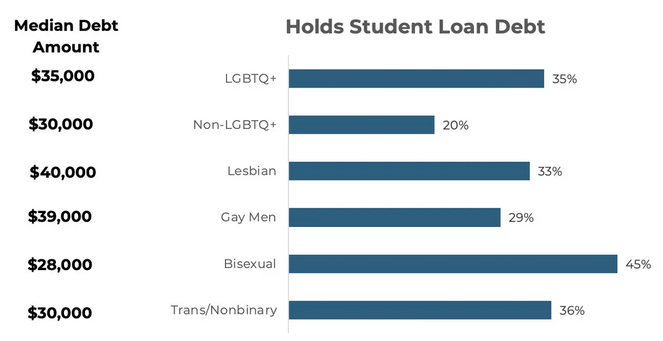
Over one in three LGBTQ+ buyers (35%) report having student loans vs. one in five non-LGBTQ+ buyers (20%). These student loan holders have higher student loan debt than their non-LGBTQ+ counterparts: a median of $35,000 vs. $30,000. Bisexuals are the most likely to hold student loan debt (45%), with lesbians and gay men reporting the highest median amounts.
LGBTQ+ buyers and sellers face different obstacles in the homebuying and selling processes than other home buyers and sellers. Bisexual and trans/nonbinary buyers and sellers in particular face more and different challenges than their lesbian and gay counterparts and may have different needs. While some of these factors are related to younger overall ages among LGBTQ+ buyers and sellers, others are intrinsic to the ways in which they walk through the world. Sensitivity to these issues will help real estate professionals better serve their LGBTQ+ clients in helping them achieve and continue homeownership in a challenging market.
Here are a few suggestions on how REALTORS® can use this:
Develop tailored marketing and outreach strategies that address the unique needs and challenges of the growing population of LGBTQ+ first-time buyers and sellers. Understanding where demand is increasing helps real estate professionals connect with the right buyers and sellers.
Include LGBTQ+ buyers in first-time buyer programs’ focus: Provide financial-planning support and resources, such as down payment assistance and educational workshops, to help LGBTQ+ clients navigate the homebuying process.
Promote inclusivity and sensitivity in branding and client interactions, ensuring LGBTQ+ clients feel welcomed and respected throughout their real estate journey.
NAR gathers data on homebuyers and sellers to provide trends and market intelligence about the latest developments in the residential market. The results are tabulated in the popular annual Profile of Home Buyer and Home Sellers (HBS). In addition, the data is extracted to create reports on various demographic snapshot reports and blogs, such as this one.
Lisa Herceg is Director of Business Insights for the National Association of REALTORS®.